Bertha (Hitachi Zosen TBM)
At 17.5 metres in diameter, the largest earth-pressure-balance tunnel boring machine ever built, bored beneath downtown Seattle to replace the Alaskan Way Viaduct.
Cutterhead diameter: 17.5 m — about 9.7× an average adult's height (1.8 m). The machine is always drawn at the same size here; the human figure is what actually scales.
01Overview
At 17.5 metres in diameter, the largest earth-pressure-balance tunnel boring machine ever built, bored beneath downtown Seattle to replace the Alaskan Way Viaduct.
02Purpose
Purpose-built for a single bore beneath downtown Seattle — replacing an earthquake-damaged viaduct without digging up the street above it.
03Historical Development
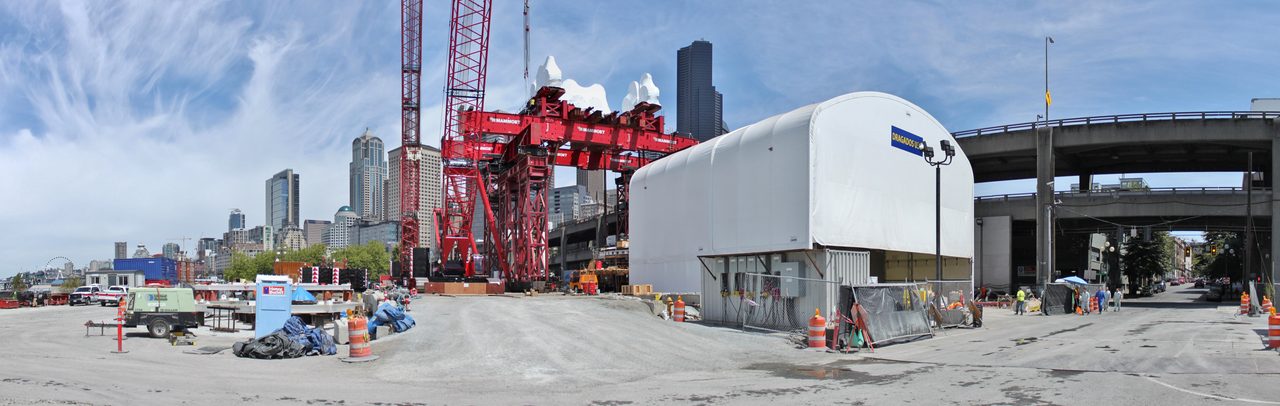
Hitachi Zosen built Bertha in Osaka for the Washington State Department of Transportation's Alaskan Way Viaduct replacement project, assembling it in Seattle in mid-2013 for a single, purpose-specific bore. It began tunnelling in July 2013, suffered a major mechanical failure after roughly 1,000 feet that halted work for about two years while it was partially disassembled and repaired in place, and finally completed its bore in 2017.
04Core Components
- CutterheadA rotating steel face fitted with 600 cutting disks that grind directly into the soil and rock ahead of the machine.
- Earth-pressure-balance chamberA sealed chamber behind the cutterhead that holds excavated material under controlled pressure, balancing the ground's own pressure to prevent surface collapse above the tunnel.
- Screw conveyorRemoves spoil from the pressurised chamber at a controlled rate without releasing that pressure suddenly.
- Thrust ramsHydraulic rams that push the entire machine forward against the finished tunnel lining behind it, segment by segment.
05How It Works
The cutterhead rotates continuously, its 600 disks fracturing soil and soft rock as thrust rams push the whole machine forward. Excavated spoil passes into the earth-pressure-balance chamber immediately behind the cutterhead, where it's deliberately kept under pressure matching the surrounding ground — too little pressure and the tunnel face can collapse; too much and it can heave the street above. A screw conveyor bleeds spoil out of that chamber at a metered rate for removal, while precast concrete segments are erected behind the machine to line the tunnel as it advances, one ring at a time.
06Engineering Principles
The cutterhead needed roughly 147,000 kN·m of torque to turn 600 grinding disks against a full-face resistance of soil and rock — among the highest torque figures of any machine on this site.
Power TransmissionBearingsThe main cutterhead bearing carries the entire rotating cutting load while sealing out extreme ground pressure and groundwater, one of the most demanding bearing applications in any machine.
GearsPlanetary GearsThe cutterhead's drive train uses staged planetary reduction gearing to turn high-speed electric or hydraulic motor output into the cutterhead's slow, immense-torque rotation.
07Performance Characteristics
| Diameter | 17.5 m (57.5 ft) |
| Length | 99 m |
| Weight | ~6,100 t |
| Installed power | 22,000 kW |
| Max thrust | 392,000 kN |
| Max cutterhead torque | 147,000 kN·m |
08Notable Examples
- SR 99 tunnel, SeattleBertha's sole project: a roughly 2.9 km tunnel beneath downtown Seattle, replacing the earthquake-damaged Alaskan Way Viaduct.
09Interesting Facts
- Bertha's mid-project breakdown, caused by a steel pipe casing that overheated its main bearing seals, halted the project for about two years while repair crews dug an access shaft down to the machine to fix it in place.
- At $80 million, Bertha was purpose-built for a single tunnel and was disassembled after completing it — TBMs of this size are rarely reused elsewhere.
- Its 600 cutting disks needed periodic replacement even mid-bore, accessed by workers entering the pressurised cutterhead chamber directly.