Caterpillar D11
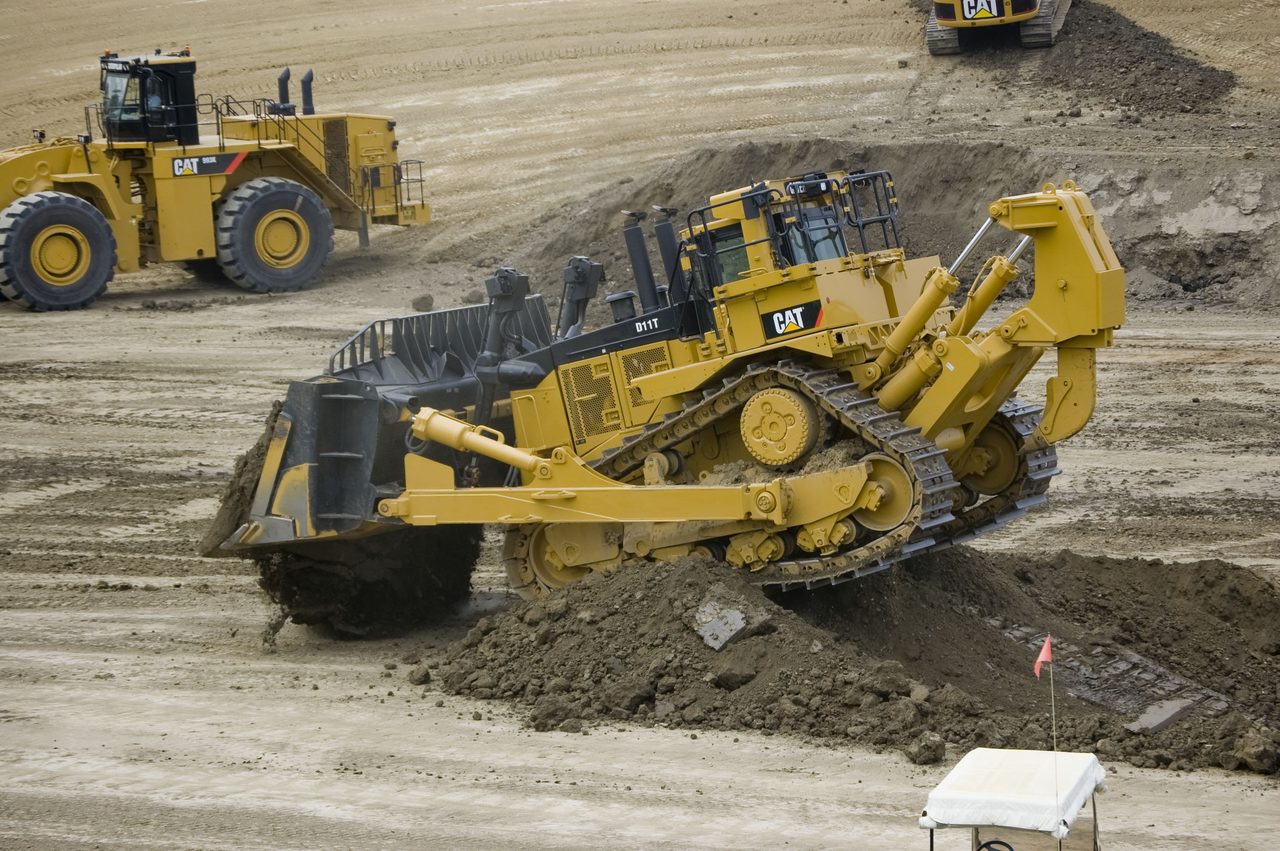
Caterpillar's largest production bulldozer, built to push more material per pass than any other dozer in its catalogue, almost exclusively in mining rather than general construction.
Overall height, top of exhaust stack: 4.5 m — about 2.5× an average adult's height (1.8 m). The machine is always drawn at the same size here; the human figure is what actually scales.
01Overview
Caterpillar's largest production bulldozer, built to push more material per pass than any other dozer in its catalogue, almost exclusively in mining rather than general construction.
02Purpose
Built for one job only: moving more material per dozer pass than anything else in Caterpillar's catalogue, on ground too demanding for a mid-size dozer to clear economically.
03Historical Development
The D11 lineage traces back to Caterpillar's push through the 1980s and 1990s to build ever-larger track-type tractors for surface mining, where a single dozer pass moving more material directly cuts cost per tonne. Successive D11 generations (D11N, D11R, D11T, and today's D11) have kept the same basic architecture — single engine, single blade, elevated sprocket drive — while steadily raising weight and horsepower.
04Core Components
- Elevated sprocket final driveKeeps the drive sprocket up and away from ground-level impact loads, protecting it from the abuse a mining dozer takes daily.
- Semi-U or U-bladeA blade profile chosen for holding more material in front of the dozer without spilling over the sides.
- Torque converter & powershift transmissionDelivers smooth, stallable power straight to the tracks, exactly what a dozer needs when it hits an immovable pile mid-push.
- Ripper (optional rear attachment)A single or multi-shank ripper that can tear up rock too hard to push directly, ahead of a following blade pass.
05How It Works
The C32 diesel drives a torque converter, which multiplies torque further at the moment the blade meets real resistance — exactly when a stalled or slow-moving dozer needs it most. That torque then passes through a planetary powershift transmission and steering system into the final drives at each track sprocket, the last and steepest gear reduction in the chain, which is what actually lets 850 engine horsepower become enough drawbar pull to shove tens of tonnes of rock.
06Engineering Principles
The torque converter is what lets the D11 stall against an immovable pile without killing the engine, then recover smoothly as the load eases.
Power TransmissionFinal Drives & DifferentialsEach track's final drive supplies the last, steepest torque multiplication, turning modest track speed into overwhelming pushing force.
MechanicsMechanical AdvantageA dozer blade is, in the end, a lever pushing horizontally — its whole geometry is chosen to maximise usable pushing force for a given engine output.
07Performance Characteristics
| Operating weight | 112.7 t |
| Flywheel power | 850 hp (630 kW) |
| Blade capacity (U-blade) | 43.6 m³ |
| Length | 10.9 m |
| Blade width | 6.7 m |
08Notable Examples
- Oil sands overburden stripping, AlbertaD11s work in tandem lines clearing overburden ahead of shovel-and-truck fleets.
- Coal mine reclamation sitesLarge dozers like the D11 regrade spoil piles back toward natural contours after mining ends.
09Interesting Facts
- Its blade alone can hold enough material to fill roughly four standard highway dump trucks in one push.
- The elevated sprocket design, distinctive on every large Caterpillar dozer since the D9H, keeps the final drive completely clear of the ground, sparing it the impact loads a low-mounted sprocket would absorb.
- A D11 costs more, new, than most single-family homes — and mining operations routinely run several at once.