Konecranes RTG
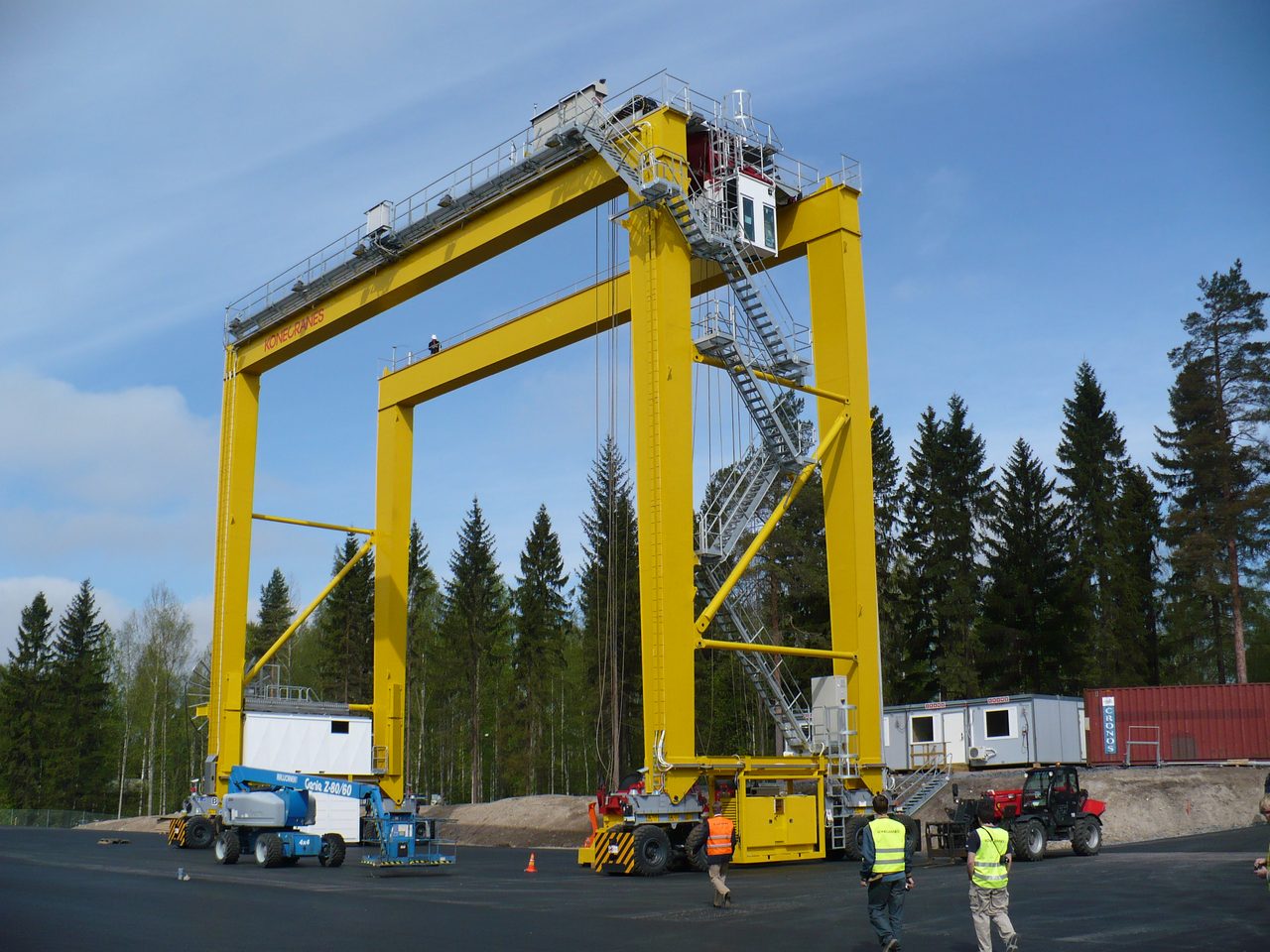
A rubber-tyred gantry crane that straddles multiple lanes of stacked shipping containers, moving on its own tyres between container blocks rather than running on fixed rails.
Estimated structure height — no manufacturer spec found; derived from clearing six stacked containers plus the beam and hoist: 25.0 m — about 14× an average adult's height (1.8 m). The machine is always drawn at the same size here; the human figure is what actually scales.
01Overview
A rubber-tyred gantry crane that straddles multiple lanes of stacked shipping containers, moving on its own tyres between container blocks rather than running on fixed rails.
02Purpose
Exists to keep a container yard's stacks organised and moving without needing fixed rail infrastructure, repositioning between blocks under its own power as vessel schedules shift.
03Historical Development
Container terminals adopted gantry cranes broadly as container shipping scaled through the late 20th century, needing something faster and more space-efficient than mobile cranes or forklifts stacking boxes several high. Rubber-tyred gantries in particular offered an advantage rail-mounted gantries couldn't: the ability to reposition between different container blocks without fixed rail infrastructure, at some cost in precision and speed compared to a railed system.
04Core Components
- Gantry legs & rubber-tyred bogiesFour (or more) corner legs on independently steerable rubber-tyred wheel sets, letting the whole crane reposition between container rows under its own power.
- SpreaderA hydraulically actuated frame that locks onto a shipping container's four corner castings for lifting.
- Hoist trolleyTravels along the gantry's overhead beam, positioning the spreader across the crane's full span.
- Active load control systemSoftware-controlled damping that counteracts container sway during hoisting and trolley travel.
05How It Works
The crane straddles a block of stacked containers on its rubber-tyred legs, wide enough to span up to eight container rows plus an additional truck lane. A hoist trolley runs along the overhead beam to position the spreader directly above the target container, lowers and locks onto its corner castings, then lifts and traverses the load to its new position — either stacking it within the block or setting it onto a waiting truck chassis in the lane below. Active load control uses the trolley and hoist drives themselves to damp out the pendulum swing a suspended container would otherwise develop, letting operators place loads precisely without waiting for the sway to settle naturally.
06Engineering Principles
The hoist and trolley drives use geared reduction to turn electric motor speed into the controlled lifting and travel speeds container handling requires.
MechanicsMechanical AdvantageThe hoist wire-rope reeving multiplies motor force exactly as any crane's rigging does, scaled to a rated capacity of up to 65 tonnes under the spreader.
MechanicsTorqueEach independently steerable wheel bogie needs its own drive torque to manoeuvre the whole gantry structure squarely between container rows.
07Performance Characteristics
| Lifting capacity under spreader | up to 65 t |
| Span | up to 8 rows + truck lane |
| Stacking height | 1-over-6 |
| Power options | Diesel, hybrid, electric, battery |
08Notable Examples
- Container terminals worldwideRTGs are the dominant container-stacking crane type at ports where fixed rail infrastructure for rail-mounted gantries isn't justified by traffic volume.
09Interesting Facts
- Because RTGs move on tyres rather than rails, an entire container yard's crane fleet can be reorganised between blocks as vessel schedules and volumes shift.
- Active load control systems can cut container-placement time meaningfully by eliminating the wait for natural pendulum sway to die down after each lift.
- RTGs increasingly run on electric or hybrid power specifically to cut the diesel exhaust and noise of running large engines continuously in a busy container yard.