M1150 Assault Breacher Vehicle
A U.S. military combat engineering vehicle built on the M1 Abrams tank chassis, purpose-designed to clear paths through minefields and obstacle belts ahead of advancing forces.
Estimated overall height — reliable spec not found for the Abrams hull plus stowed mine-clearing gear: 3.0 m — about 1.7× an average adult's height (1.8 m). The machine is always drawn at the same size here; the human figure is what actually scales.
01Overview
A U.S. military combat engineering vehicle built on the M1 Abrams tank chassis, purpose-designed to clear paths through minefields and obstacle belts ahead of advancing forces.
02Purpose
Built for exactly one mission: clearing a path through mines and obstacle belts before anyone else in the formation has to cross them.
03Historical Development
Combat engineering vehicles built on main battle tank chassis date back decades, on the logic that a vehicle clearing a path under fire needs the same armour protection as the tanks following behind it. The M1150 ABV replaced earlier, less-protected mine-clearing vehicles by mounting breaching equipment directly onto a standard M1A1 Abrams hull, giving breaching crews the same survivability as the armoured units they support.
04Core Components
- Full-width mine plowA hydraulically actuated plow blade that digs into the ground ahead of the vehicle, physically displacing buried mines out of the vehicle's path.
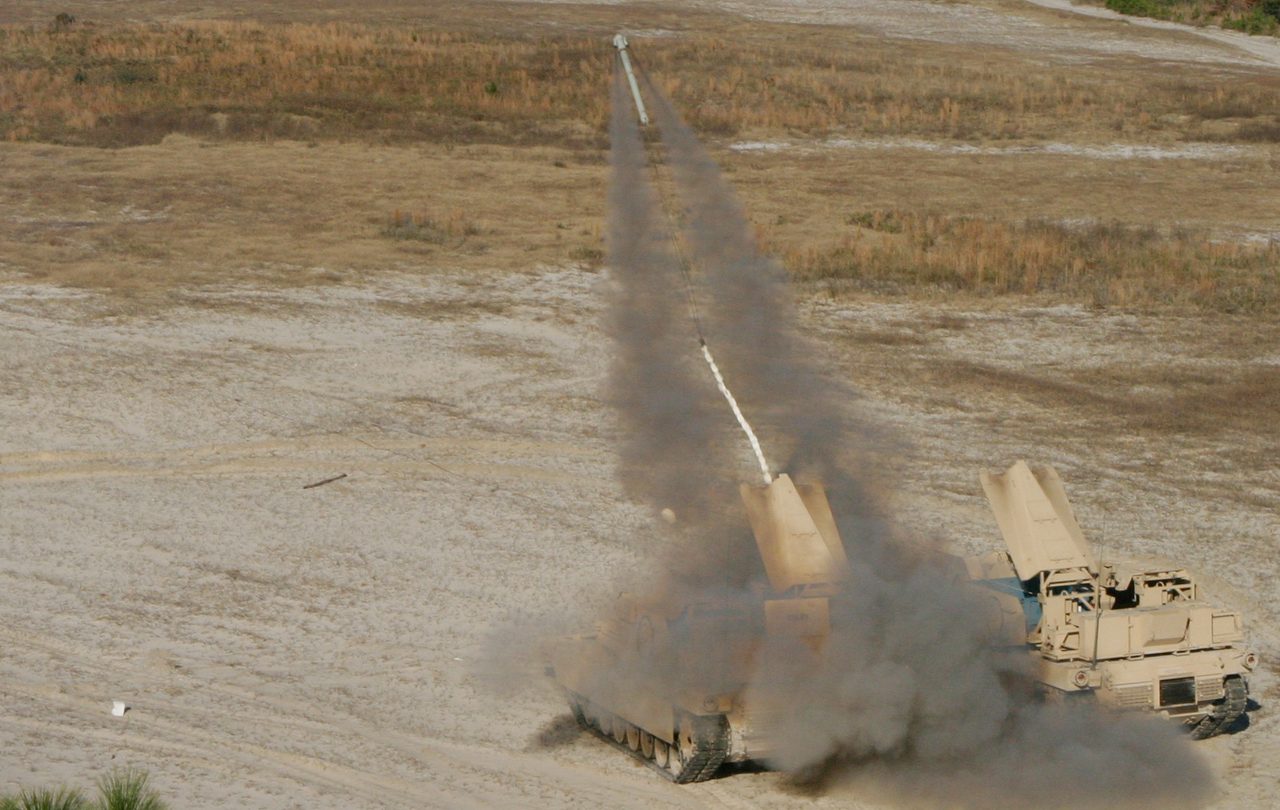
- Mine-clearing line charge (MICLIC) launchersRocket-propelled explosive line charges that detonate across a path ahead of the vehicle, clearing mines and obstacles over a distance no plow alone could cover as quickly.
- AGT1500C gas turbine engineThe same 1,500 hp multi-fuel turbine engine used in the M1 Abrams, retained here for shared logistics and parts commonality.
- Modified hull (no main gun turret)The Abrams' turret and main gun are removed and replaced with the breaching equipment and a remote weapon station.
05How It Works
Approaching an obstacle belt, the ABV's crew can fire a rocket-propelled mine-clearing line charge ahead of the vehicle; the rocket drags a long explosive-filled hose across the ground, and detonating it clears a path by exploding or displacing buried mines across that whole length in a single event. For obstacles the line charge doesn't fully clear, or once a general lane is established, the vehicle's full-width mine plow drops and physically pushes any remaining buried mines or debris aside as the vehicle advances, both operations conducted from behind the same armour protection as the Abrams tanks it's built alongside.
06Engineering Principles
The Abrams-derived transmission uses a torque converter to deliver smooth, stallable power to a 72-tonne vehicle across the same range of ground conditions the base tank handles.
Power TransmissionFinal Drives & DifferentialsTrack final drives, shared with the base M1 Abrams platform, deliver the last torque multiplication to each track at this vehicle's very high combat weight.
HydraulicsHydraulic CylindersThe mine plow's raising, lowering, and depth control are all hydraulically actuated.
07Performance Characteristics
| Weight | ~72 t |
| Engine | AGT1500C gas turbine, 1,500 hp |
| Top speed | 42 mph (67 km/h) |
| Crew | 2 |
08Notable Examples
- U.S. Army and Marine Corps combat engineer unitsThe ABV equips dedicated breaching companies tasked with opening lanes through minefields and obstacles ahead of manoeuvre forces.
09Interesting Facts
- Its gas turbine engine, shared with the M1 Abrams, can run on multiple fuel types — a deliberate logistics choice for a vehicle that has to keep running wherever the tanks it supports are refuelled.
- A single MICLIC rocket-and-line-charge system can clear a path roughly 100 metres long and 14 metres wide in one detonation.
- Removing the Abrams' turret and main gun to fit breaching equipment means the ABV relies on the armoured units around it for direct firepower, carrying only a remote-operated machine gun for self-defence.